
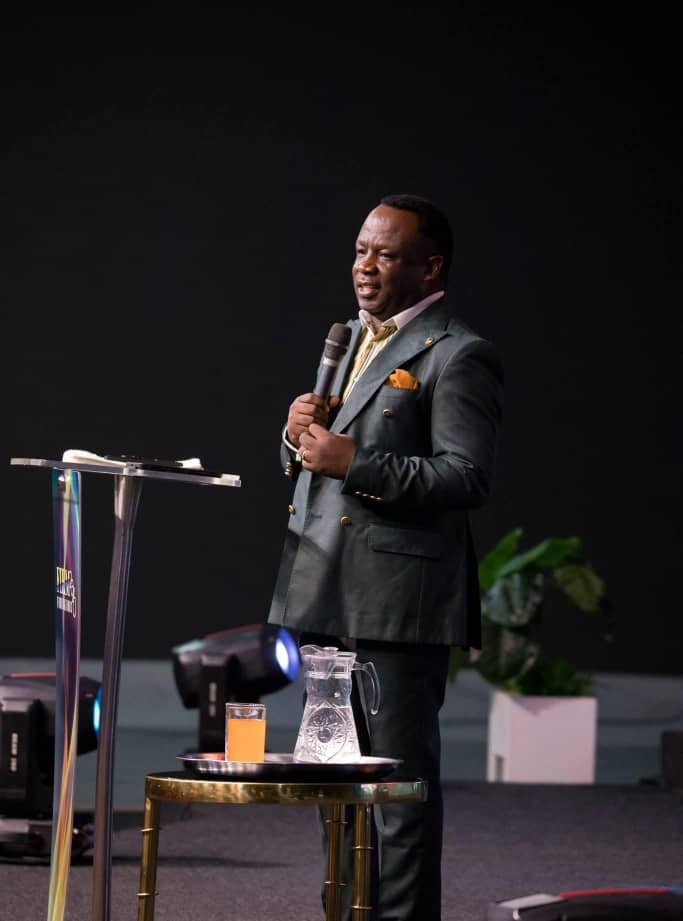
Day Four of the Firm Foundations Conference delivered a deeply reflective message as Apostle Munetsi Sande unpacked the principle of impartation, explaining how spiritual transfer operates through positioning, surrender and alignment rather than personal striving.
Using a vivid illustration, Apostle Sande taught that impartation flows from a region of higher concentration to a lower one. He likened a spiritual father to pure water—clear, refined and operating from a “paid-for” place of grace and authority—while describing spiritual sons and daughters as concentrated juice, rich in potential but requiring dilution and refinement.
“The purity does not weaken the juice,” Apostle Sande explained. “It clarifies it.” According to the teaching, when believers position themselves correctly, what flows from a spiritual father is not control or limitation, but purification, alignment and character transformation. The emphasis, he noted, is not on effort but on receptive surrender.
Apostle Sande stressed that impartation is not automatic; it requires willingness and humility. Without openness, even the highest concentration of grace cannot effectively flow. “The power is not in striving to become,” he said, “but in yielding to receive.”
Connecting this principle to Scripture, Apostle Sande referenced 2 Corinthians 5:17, which declares that if anyone is in Christ, they are a new creation. He emphasised that the phrase “in Christ” speaks of connection to the ultimate Source. In this union, believers do not work for transformation; they partake of it.
Spiritual impartation functions in the same way. When believers align themselves within God-ordained spiritual structures, the finished work of Christ flows into their lives, shaping identity, renewing mindset and establishing authority. Dominion, Apostle Sande taught, begins not with personal ambition, but with standing firmly in grace that has already been paid for.
He further explained that many struggle unnecessarily because they attempt to produce results through effort rather than reception. “Grace is not earned,” he noted. “It is received.” Impartation, therefore, is less about activity and more about correct positioning—being present, available and teachable.
As the session concluded, Apostle Sande reiterated that true transformation is not dilution of calling, but refinement of character. When believers remain connected—both to Christ and to the spiritual vessels God uses—what flows into them strengthens rather than diminishes their purpose.
Lasting dominion flows from alignment with grace. In Christ and through Godly impartation, believers step into authority not by striving, but by standing in what has already been accomplished.